Journal · Sovereign AI · 11 Nov 2026
Numes opens a marketplace for AI compute
A new marketplace sells AI by the request, paid in dollars or sats, and lets anyone with a spare GPU sell their capacity.
Reported By Daniel · · 4 min read · 5 sources
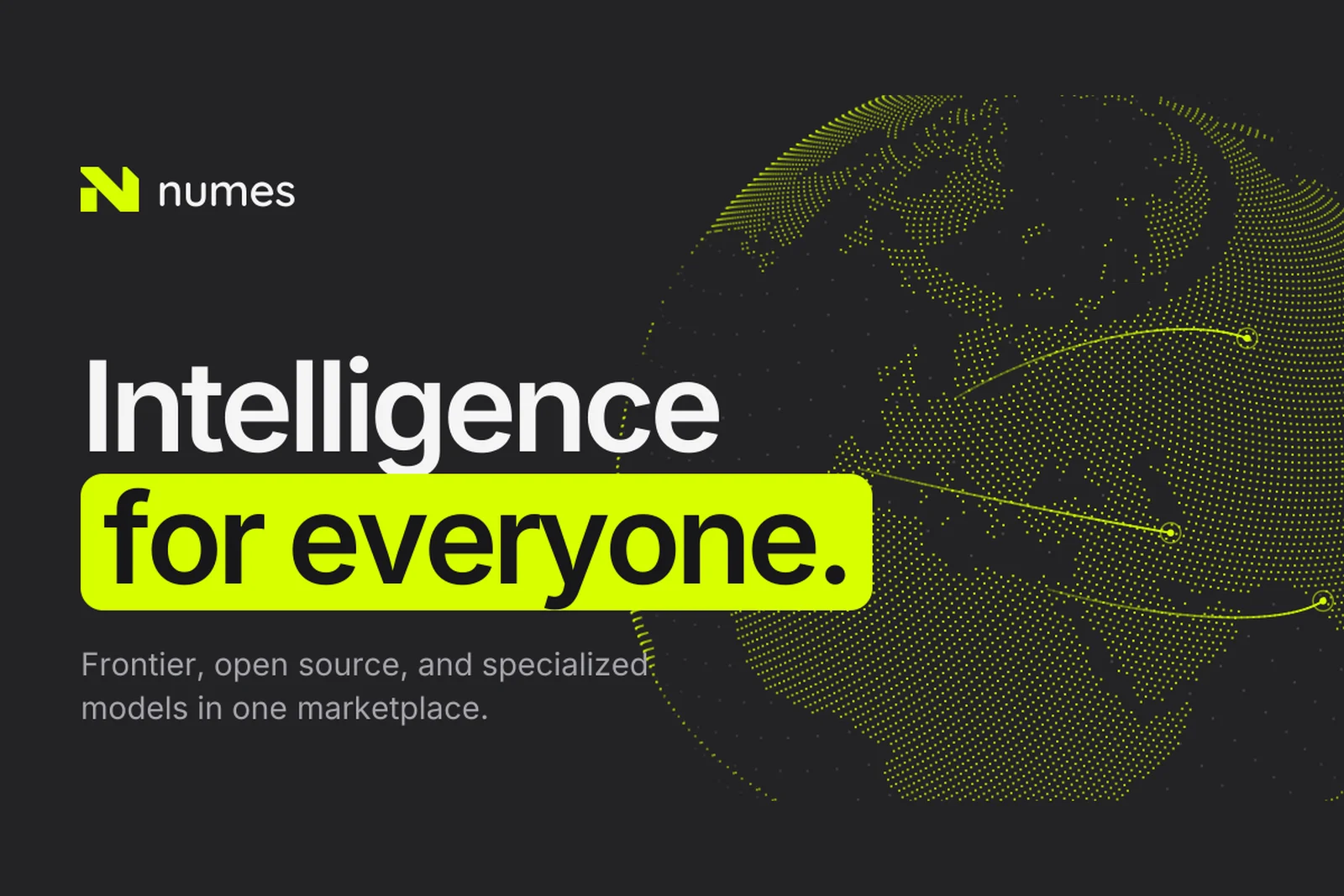
If you use AI today, you most likely rent it from one of a few companies, at a price they set. Numes, which went live on 10 November 2026, wants to change that. It calls itself "an open marketplace for the world's AI compute," and the idea is simple: many providers offer the same models, and each request goes to the cheapest one working.
On Numes, independent providers serve the models, you reach all of them through one API, and you pay by the request from a balance in dollars or in Bitcoin. It is OpenAI-compatible, so existing code works after a change of address and key.
I think this is the right way to sell AI, and the reason is price. Running a model keeps getting cheaper, and competition is what passes that saving on to the people paying for it.
Why competition matters
Think about how you buy AI from a single lab. The lab sets the price, and it decides when falling costs get passed on. A marketplace takes that decision away. Numes says it compares "live price, speed, and reliability" and routes each request to a provider that is answering right now, so a provider who cuts its price wins more of the work straight away. If a provider fails before an answer arrives, the request moves to the next one at no cost.
No single company decides which models are worth offering, which matters while open models keep improving. Anyone with a spare GPU can install the Numes agent, set a price and earn from hardware that would otherwise sit idle. Calle, who created the Bitcoin ecash protocol Cashu, put it this way on X: "Proudly presenting Numes. For people who use AI and for people who power it."
Where AI prices are going
Storage and bandwidth were expensive once, and now nobody counts them. AI is on the same road. What began as a research budget became a monthly subscription, and I expect it to end up as a small line on a statement next to your other bills. Jeff Booth makes the case for prices like these falling in The Price of Tomorrow, which argues that technology keeps pushing them down.
When prices fall that far, the question that matters is who keeps the saving. A company that owns the best model can hold its price for a while, since nobody can buy the same answer elsewhere. A market cannot, because the cheapest offer that works gets the job. That is why the routing matters more to me than any single model on the list.
Payment is the other half. If software is going to buy small pieces of work from other software, it needs money that can move a few sats at any hour to a seller it has never met, without a bank in the middle. Card networks were built for people paying at a till, and a charge of a few sats makes no sense on them. Lightning was built for payments this small, which is why I expect markets like this to settle more and more in Bitcoin.
Numes already works the way that future needs, and its Bitcoin side is still early. You need an account tied to an email to call the API. Every price in the catalogue is in US dollars for now, and a Bitcoin key only sees offers priced in sats, so a sats balance may have nothing to buy until providers list prices in Bitcoin. Topping up with Bitcoin also costs 5%.
Paying in sats, and what you trust
You fund a Bitcoin balance over Lightning or on-chain, and Numes says Lightning payments are "usually credited within seconds", according to its Bitcoin payments page. Each API key is set to dollars or Bitcoin when you create it, so a Bitcoin key prices everything in sats, and a single request can cost a handful of them. Bitcoin payments can't be refunded, and automatic top-up only works by card.
Because anyone can apply to sell, the checks matter. "Anyone can apply to sell inference on Numes, so no endpoint is trusted because a provider says so," Numes writes on its verification page. Every offer goes through a review of the provider, the model and the price, plus capability and health checks before it gets traffic, and a provider caught misrepresenting a model is suspended and loses its earnings. Numes names the limit in its principles: "Verification isn't proof of weights."
Privacy works in two layers. Numes says it keeps no prompts or responses, only metadata such as the model, the provider and the cost. The provider that runs your request does see what you send. You can use the zdr routing option to send requests only to providers that keep nothing, and encrypted models on attested hardware are on offer too.
Where to start
If you want to try it, this is the order I would go in:
- Browse the catalogue without signing up. Prices and measured speed are already there.
- Create a Bitcoin key and check that it lists models before you fund it.
- Start with the smallest preset, 10,000 sats, and use zdr routing.
- Compare the cost with running a small model at home, which is still the most private option.
- If you have a GPU sitting idle, read the provider docs and list it at your own price.
I will be watching the catalogue for the first offers priced in sats.
Related: Few guide: private AI at home.
Image: Numes, numes.ai. Read as Markdown · RSS
Sources
- Numes, launch post on X, 10 November 2026. x.com/Numes_ai/status/2120206348495499278
- Calle, post on X, 10 November 2026. x.com/callebtc/status/2120208564728050107
- Numes, homepage and docs: Quickstart, Bitcoin payments, Verification and trust, Principles, For providers (numes.ai), read 11 November 2026. numes.ai/docs/quickstart
- Numes, public model catalogue, 11 November 2026. numes.ai/models
- Jeff Booth, "The Price of Tomorrow: Why Deflation Is Key to an Abundant Future" (Stanley Press), 2020. thepriceoftomorrow.com/